
Every founder has a product vision. It’s clear in their head — the product they want to build, the market they want to serve, the problem they’re going to solve. The difficulty is rarely the product vision itself. It’s that the vision usually exists as two separate things: a technical picture of what could be built and a commercial picture of what the market will pay for. Those two pictures live in different people’s heads, get articulated in different ways, and point in subtly different directions.
The real work of creating a product vision for a startup isn’t writing a vision statement. It’s uniting those two perspectives into a single story that holds up in front of investors, customers, and co-founders — each of whom needs a different framing of the same underlying direction.
A product vision for a startup is the unified direction that connects what can be built with what the market needs — expressed clearly enough to drive funding, hiring, and product decisions before a product exists. It’s not a roadmap or a feature list. It’s the answer to two questions asked together: what problem are we solving, and what kind of company does solving it make us?
Table of Contents
Why Does a Startup Need a Product Vision Before Building Anything?
In the earliest days of building something, you have a rough image of what the product could be and what the business might become. That rough image is your product vision in its rawest form — vivid to you, untested against anyone else’s understanding of the world, and certainly not shaped into something you can put in front of someone who controls a chequebook.
When I co-founded Data Solver, we didn’t have wireframes. We didn’t have a prototype. We had a problem statement built from personal experience and a conviction that the market was moving in a direction that would make our solution valuable. GDPR was reshaping how organisations thought about data — similar to the way AI is grabbing market attention now — and we could see an opportunity in that shift.
But conviction isn’t a pitch. To get anywhere, we needed to articulate the product vision in a way that made sense to people who hadn’t spent months living inside the problem. And before we could even do proper customer research to validate our thinking, we needed funding — which meant convincing someone to invest in the proof before the proof existed.
This is the circular challenge most founders face. You need the product vision to get funding. You need funding to validate the product vision. The way through it is to get exceptionally clear on three things: the problem statement, the size of the problem, and the urgency behind it. At Data Solver, we zeroed in on those three before we had anything else. We could articulate what was broken, how many organisations were affected, and why the timing was right. That clarity — not a prototype, not a demo — was what got us our first funding to build wireframes and start real customer conversations.
The product vision at this stage isn’t a finished artefact. It’s a thinking tool. And it will change — that’s not a failure, it’s the process working.
What Are the Two Visions Every Founding Team Needs to Align?
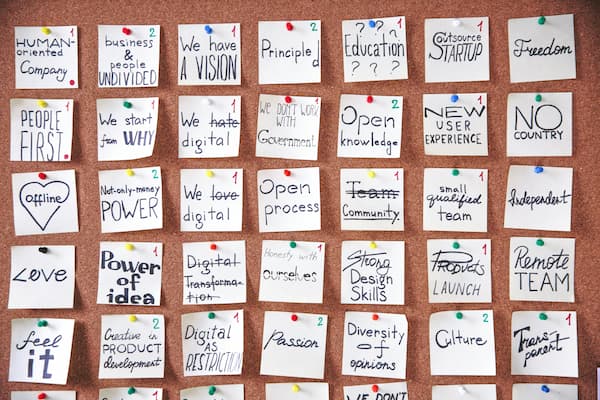
Most content about product vision treats it as a single thing. In practice, every founding team carries two visions that need to become one.
The first is the technical vision — what’s possible to build, how the architecture should work, what the technology can and can’t do, and what sequence of development makes sense. This usually lives most clearly in the technical co-founder’s head.
The second is the commercial vision — the market opportunity, who pays, how they buy, what the competitive landscape looks like, and why the economics work. This lives in the commercial co-founder’s head.
Both are valid. Both are necessary. And they almost always point in slightly different directions. Uniting them requires what designers call divergent and convergent thinking — first expanding the space of what’s possible before narrowing toward a decision. Most founding teams skip the expansion and jump straight to convergence, which is how you end up with a product vision that’s really just a plan in disguise.
With Data Solver, we started where most MBA founders start: macro analysis of the market. Market size, the regulatory tailwind (GDPR), gap analysis, competitive landscape. That gave us the commercial side of the product vision. Simultaneously, the technical co-founder was thinking about platform architecture — what to build first, how the components would connect, what was technically feasible within our constraints.
The tension between those two perspectives showed up most clearly when we tried to agree on what to build first. From a technical standpoint, there’s always a desire to build a thorough, well-architected product. From a commercial standpoint, there’s pressure to get something in front of customers as quickly as possible — but not something so rough that it undermines credibility. The question that kept surfacing was: what is the minimum slice of value we can deliver and still be taken seriously?
That question — minimum slice of value — became the bridge between the two visions. It forced the technical side to think commercially (what’s the smallest thing a customer would actually pay for?) and the commercial side to think technically (what does it actually take to build this to a standard we can stand behind?).
The answer isn’t a compromise. It’s a genuine integration of both perspectives, and reaching it requires the kind of honest conversation that most founding teams avoid because it surfaces uncomfortable disagreements about priorities, timelines, and what “good enough” actually means.
How Do You Test a Product Vision Before You Have a Product?
The short answer: you talk to everyone who will listen, and you get very disciplined about what you do with the feedback.
At Data Solver, we were fortunate to be in a university ecosystem with access to accelerator programmes. This gave us a constant stream of opportunities to pitch — formal structured sessions and informal conversations alike. Some of the most valuable feedback came from elevator pitches: sixty seconds to explain what we were building and why it mattered, then a conversation if we’d earned one.
We treated these as mock trials for the product vision. Not rehearsals for a specific pitch, but genuine tests of whether the product vision was landing. Were people understanding the problem? Could they see why the solution was valuable? Did they care?
The single biggest learning from those early conversations was this: we were leading with technology when we should have been leading with customer outcome.
As founders, we were naturally drawn to talking about the product — the architecture, the innovation, what made it technically differentiated. But the people we were talking to — potential customers, potential investors, people in the legal sector — weren’t interested in the product. They were interested in the outcome the product would create and why that outcome was worth paying for.
That shift — from product-first to outcome-first — changed everything about how we presented the product vision. The emphasis moved to value: what does the customer get, why is it important, and why will they pay for it? The technology became the proof that we could deliver the outcome, not the headline.
These conversations also changed more than just the language. They reshaped the strategy itself. Through sustained conversations with people across the legal sector — customers, investors, practitioners — we gradually realised there was a reseller opportunity we hadn’t anticipated. Consultancies could white-label our product and sell it to their own clients, which expanded the market profile from direct sales to law firms into a much broader channel. That insight didn’t come from one conversation. It was a gradual realisation across many, and it created productive tension in the founding team because it meant rethinking the roadmap, the branding approach, and the order in which we’d build things.
What had been the second priority on our product roadmap moved to fifth, and what had been fifth moved to second — directly because of what these conversations revealed about where the real commercial opportunity sat.
The practical takeaway for founders: mock trials aren’t just pitch practice. They’re product vision refinement. But you have to be disciplined about curating the feedback. We talked to everyone who was willing to listen, but we were careful about which feedback we actually incorporated. Not every perspective is equally useful, and the temptation to reshape your vision after every conversation will pull you in too many directions if you let it.
What Is the Difference Between a Product Vision and a Product Strategy?
The vision is where you’re going. The strategy is how you get there. Most founders get pushed to write the strategy first — accelerator templates, investor expectations, and the sheer pressure to show a plan all pull in that direction. But writing the strategy before the product vision is clear leads to incremental thinking. You optimise for what’s in front of you rather than building toward something worth reaching.
The sequence matters because the product vision is what gives the strategy its logic. At Data Solver, the white-label and reseller opportunity that emerged from customer conversations changed the strategy significantly — different go-to-market, different pricing model, different build order. But the core product vision — solving a specific data problem for organisations navigating regulatory complexity — held steady. The destination didn’t change. The route did.
That distinction is important because founders face a constant question: when customer feedback or market signals suggest a change, is this a strategy shift or a product vision shift? The test I’ve found useful is simple: has the core problem statement changed? If the problem you’re solving is still real and urgent, the product vision holds and the strategy adapts around it. If the problem itself has shifted — if the market has moved on, or your understanding of the customer need has fundamentally changed — then the vision needs reworking, not just the strategy.
Both happened at Data Solver. The strategy evolved continuously as we learned more about the market. The vision evolved too, but more slowly and more deliberately — shaped by the accumulation of customer conversations rather than by any single data point.
For founders navigating this: hold the product vision loosely enough to let it evolve, but firmly enough that you’re not rewriting it every time someone gives you feedback. The difference between a pivot and drift is whether the change is deliberate.
How Do You Get Investor Buy-In for a Vision That Doesn’t Exist Yet?
This is the specific challenge of pre-product fundraising: you’re asking someone to fund something that has no demo, no revenue, and no proof beyond your conviction and your research. The vision has to do all the work.
What I learned at Data Solver is that different investors need fundamentally different framings of the same product vision. We ran pitches for university grant funding, for an Innovate UK grant, and for angel investors — and these were not the same pitch with minor tweaks. They were structurally different presentations of the same underlying product vision.
The Innovate UK pitch centred on technical innovation, societal impact, and alignment with their focus areas — at that time, cyber security. The emphasis was on what was novel about our approach and why it mattered beyond commercial returns. Angel investors needed a different story: market size, route to revenue, competitive differentiation, and a credible path to returns. Same vision, completely different architecture for communicating it.
What worked across all of them was building the pitch around proof of demand rather than proof of product. We had spoken to people within our target customer profile. We had warm contacts who had validated the problem. We went further: we asked potential beta customers to sign non-binding memoranda of understanding, committing to test the product for a defined period and buy at a reduced rate when it was ready. These weren’t contracts, but they demonstrated a level of seriousness from decision-makers that pure market sizing can’t match.
The approach worked. We secured a £250,000 Innovate UK grant and went on to raise £1.5 million in total. The funding wasn’t the result of a polished pitch — it was the result of a product vision that had been tested, reshaped, and pressure-tested through dozens of conversations before it ever reached an investor’s desk.
What Happens When Co-Founders See Different Visions?
Every founding team will hit a point where the two visions — technical and commercial — reveal a genuine gap. This isn’t a crisis. It’s a signal that the integration work hasn’t been completed yet. As Paul Graham has noted, you can change your idea easily, but changing your co-founders is hard — which is precisely why getting the product vision aligned early matters so much.

The most common version of this is the expectation mismatch around delivery. The commercial side of the team sees a wireframe and imagines a product that’s nearly ready. The technical side knows the wireframe is a sketch — that the distance between a wireframe and a working product involves architectural decisions, infrastructure, testing, and iteration that can’t be shortcut. The gap between what a wireframe represents and what a clickable prototype actually demonstrates is significant, and founding teams that don’t make that distinction explicit will end up in conflict about timelines that are rooted in genuinely different understandings of what’s been built.
This is remarkably similar to what happens when product management is introduced into an organisation that has never had it. The expectation mismatches — about what’s possible, how long things take, what “done” means — are structural, not personal. They come from different mental models of the same work.
The fix is making the gap visible rather than papering over it. When co-founders disagree about what to build first or how long it will take, the productive move is to go back to the minimum slice of value question: what is the smallest thing we can deliver that a customer would find genuinely useful? That question forces both perspectives into the same frame and usually reveals where the real disagreement lives — which is rarely about the product vision itself, but about the sequencing and standards required to deliver it.
When Should a Founder Revisit Their Product Vision?
Often. But deliberately.
Product vision drift in startups is fast because the pressure to say yes to every opportunity is enormous. Every customer conversation, every investor question, every competitor move creates a temptation to adjust. Some of that adjustment is healthy — it’s the product vision evolving as your understanding of the market deepens. Some of it is drift — the vision slowly losing its shape as you accommodate too many competing inputs.
At Data Solver, customer conversations changed our customer profile, our go-to-market approach, and the priority order of our product roadmap. The selling model expanded from direct sales to a reseller channel. The build sequence shifted significantly. All of that was healthy evolution driven by genuine market learning.
The test I keep coming back to: is the core problem statement still true? If you’re still solving the same problem for the same reason, the product vision is intact and the strategy is adapting. If you find yourself solving a different problem, or solving the original problem for a fundamentally different reason, that’s a product vision shift — and it deserves to be treated as one rather than drifting into it unconsciously.
Revisiting the product vision doesn’t mean rewriting it. It means stress-testing it against what you now know. The best time to do this is after a meaningful batch of customer conversations, after a significant change in the competitive landscape, or when you notice that the roadmap no longer connects clearly to the original direction. The worst time is mid-sprint, when the pressure of delivery makes everything feel urgent and nothing feels strategic.
The Real Work
The product visions that get funded, that attract co-founders, that survive the first year of building — they aren’t the ones that were perfectly articulated from day one. They’re the ones that started as two separate pictures in two different founders’ heads and were gradually, sometimes painfully, unified into a single direction that held up under scrutiny.
That unification isn’t a one-time exercise. It’s ongoing work — shaped by every customer conversation, every pitch, every moment where the technical reality and the commercial ambition have to be reconciled. The founders who do this well aren’t the ones with the best slide decks. They’re the ones willing to keep having the uncomfortable conversation about what they’re actually building, who it’s really for, and whether both sides of the product vision still point the same way.
If you’re in the early stages of building something, start there. Not with the roadmap. Not with the pitch deck. With the honest question: do the people building this see the same destination?
Frequently Asked Questions
What is a product vision for a startup?
A product vision for a startup is the unified direction that connects what can be built technically with what the market will pay for commercially. It answers two questions together: what problem are we solving, and what kind of company does solving it make us? It’s not a feature list or a roadmap — it’s the destination that informs every product, hiring, and funding decision.
How do you write a product vision before you have a product?
Focus on three things: the problem statement, the size of the problem, and the urgency behind solving it now. You don’t need a prototype to articulate a vision — you need clarity about what’s broken, who it affects, and why the timing is right. Test that articulation through conversations with potential customers, investors, and advisors, and let the feedback refine both the language and the substance.
What is the difference between a product vision and a business plan?
A product vision defines the destination — what you’re building and why it matters. A business plan describes the mechanics of getting there — revenue model, operational structure, financial projections. The vision should come first because it gives the business plan its logic. A business plan without a clear vision will optimise for short-term feasibility rather than long-term ambition.
How do you align co-founders on product vision?
Make the gap between the technical vision and the commercial vision visible and explicit. Most co-founder misalignment isn’t about the destination — it’s about different assumptions regarding what’s required to get there. Use the minimum slice of value question to find common ground: what is the smallest thing you can deliver that a customer would find genuinely useful?
When should a startup pivot its product vision?
When the core problem statement is no longer true — either because the market has moved, your understanding of the customer need has fundamentally changed, or you’ve discovered that the problem you set out to solve isn’t the one that matters most. If the problem statement still holds but the route to solving it has changed, that’s a strategy pivot, not a vision pivot. The distinction matters because it determines how much needs to be rethought.
How do you present a product vision to investors?
Different investors need different framings. Technical or grant-based investors want to understand the innovation and its broader impact. Commercial investors want market size, route to revenue, and competitive differentiation. In both cases, proof of demand — conversations with potential customers, letters of intent, or early commitments — is more persuasive than market sizing alone. Frame the vision around the outcome for the customer, not the features of the product.