
How to write a product brief: You’ve thought through the product. The logic is clear in your head. You write it up, hand it to a developer or a design agency, and wait.
What comes back is close — but not quite right. A flow that doesn’t match what you imagined. A feature that solves a slightly different problem. A build that took three weeks in the wrong direction.
Or you share it with an early sales hire and get blank looks. Or you present the thinking to an investor and the commercial logic you thought was obvious hasn’t landed at all.
The brief wasn’t incomplete. It was written for the wrong person — and shared too late for the right people to shape it.
What Is a Product Brief?
A product brief is a communication tool that ensures everyone involved in building, selling, or backing a product is working toward the same vision. Its purpose isn’t to document what you’re thinking — it’s to align what the development team is creating with what the sales team is selling and what investors are backing, so that the product that reaches customers matches the one the founder imagined.
The most common brief failure isn’t missing information. It’s that the brief was written for the person creating it rather than the people who need to act on it.
Table of Contents
Why Do Product Briefs Fail?
Most founder briefs fail for one of three reasons — and all three are fixable.
Written for the person creating it, not the person receiving it: An engineering team needs edge cases and technical clarity. An investor needs commercial logic. A sales hire needs customer language. The same brief cannot serve all three. When it tries to, it partially serves each one and fully serves none.
Shared too late: Most briefs arrive after the thinking has hardened. The developer, the investor, the sales person — they’re handed something finished and asked to execute or evaluate. The people who would have asked the right questions, spotted the gaps, and made the brief better never got the chance. Getting the right people involved before the brief is finalised — not after — changes the quality of what gets built.
Nobody challenged it before work started: This is particularly common with outsourced teams. The brief goes out, the agency says yes, work begins. Weeks later the output is different from what was expected — not because anyone was negligent, but because nobody pushed back at the start. A party that challenges your brief before they begin is more valuable than one that accepts it without question. Build that expectation in from the first conversation.
What Does a Product Brief Need to Cover?
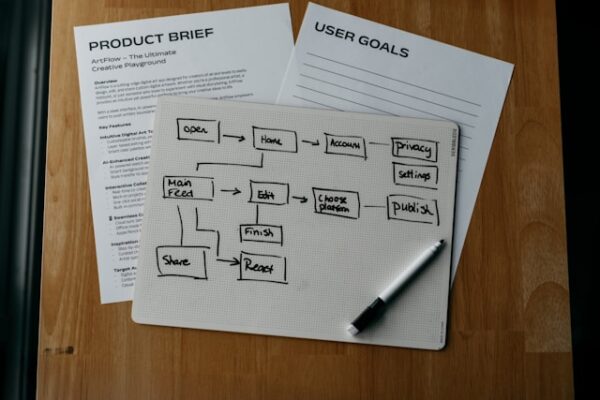
Regardless of who is receiving it, five things need to be clear:
- The customer and their problem — specific, not generic. Not “enterprise clients struggle with compliance” but “a compliance officer at a 200-person firm spends three days before each audit reconciling data manually.” Concrete problems produce concrete solutions.
- The desired outcome — what changes for the customer after this exists. Not what gets built — what gets better.
- The role this brief is playing — are you briefing a developer to build, a designer to prototype, an investor to back, a sales hire to sell? Each needs a different emphasis. State it explicitly.
- The constraints that matter — timeline, budget, technical dependencies. Not an exhaustive list — the ones that will affect decisions.
- The definition of done — what does a successful output look like, and how will you know when you’ve got there.
How Do You Write a Product Brief for Different Audiences?
Before writing a word, ask: who is receiving this, and what do they need to be able to do after reading it? That question changes the language, the structure, and the level of detail.
- For a developer or engineering team: Lead with the problem and the edge cases. What happens when things go wrong, when a user does something unexpected, when the data is incomplete. Use precise language. Remove anything that reads like marketing. Engineers are motivated by the clarity of what they’re being asked to build — not by the commercial opportunity behind it.
- For an investor: Lead with the commercial logic. Why is this problem worth solving at scale, why is this the right solution, why now. Distinguish between a technical investor who wants to understand the architecture and a commercial one who wants to understand the revenue model. Same facts, told differently.
- For a sales team: This is the most important brief a founder writes — if the sales team can’t sell what’s been built, the product fails at the first commercial hurdle.
The approach that works is similar to Amazon’s press release and working backwards method: start with what the product does for the customer before describing what it is. What problem does it solve, what does the customer gain, what can it do that nothing else can? That’s the brief a sales team can use. Feature lists and technical specifications are noise in a sales context. Outcome, customer value, and defensible differentiation are signal.
Translate everything into the language a customer would use. If it wouldn’t come up in a customer conversation, it probably doesn’t belong in a sales brief.
Why Do Outcomes Matter More Than Features in a Product Brief?
The single biggest improvement most founders can make to how they write briefs is shifting from feature-oriented to outcome-oriented language throughout.
Feature-oriented: “Build a dashboard that shows emissions data by supplier.”
Outcome-oriented: “Enable a sustainability manager to identify their highest-emission suppliers in under two minutes, so they can prioritise reduction conversations before quarterly board reporting.”
The second version contains the first — the dashboard is implied. But it also contains the customer, the specific task, the time constraint, and the commercial context. A developer building from the second version makes better decisions. A sales hire presenting from it has a story. An investor reading it understands the value.
Most importantly, outcome-oriented language briefs the problem — not just the solution. That gives the whole team the context they need to make good decisions, including ones you haven’t anticipated.
Does a Product Brief Have to Be a Document?

No. One of the most common misconceptions about product briefs is that they need to be long and formal.
A product brief can be a one-page summary, a rough visual with annotations, a short recorded walkthrough, or a conversation followed by a concise written summary of what was agreed. With AI design tools, a brief can even take the form of a clickable prototype that communicates the vision more clearly than any written document could.
The format matters far less than whether the person receiving it understands the outcome they’re working toward.
One important caution: a brief that is too prescriptive reduces the quality of what gets built. Engineering teams, designers, and creative collaborators bring expertise a founder simply doesn’t have. When a brief leaves room for them to find better solutions, the result is often more elegant and more durable than what was originally imagined.
Be specific about the outcome. Be clear about the constraints. Leave room for better answers than the ones you came in with.
The Quick Test Before You Share Anything
Before sending any brief, three questions:
- Would the person receiving this know exactly what they’re being asked to do? If there’s any ambiguity about the expected output, it isn’t finished.
- Is it written in their language, around their concerns? If you’ve written it for yourself and addressed it to someone else, rewrite it.
- Does it state the outcome, not just the feature? If it describes what to build without explaining what changes for the customer, add that before it goes anywhere.
A brief that passes those three tests will produce better output — from a developer, a designer, an investor, or an AI tool — than one that doesn’t, regardless of how much detail it contains.
What is the difference between a product brief and a product requirements document (PRD)?
A product brief covers the why — the outcomes the product is trying to achieve, the customer value it creates, and the background context for why it’s being built. A PRD covers the what — the specific features and functionality required to achieve those outcomes, how success will be measured, and the leading indicators that will track progress. For early-stage founders, the brief comes first and informs the PRD. Trying to write a PRD before the brief is clear is one of the most common reasons development goes in the wrong direction.
How long should a product brief be?
As long as it needs to be to answer the five core questions — no longer. For an early-stage founder briefing a small development team or an outsourced agency, one to two pages is usually enough. The length of a brief is not a measure of its quality. A brief that is too long gets skimmed, misunderstood, or ignored. A brief that is too short leaves gaps that get filled with assumptions. The right length is the one that leaves no ambiguity about the outcome, the audience, and the definition of done.
When should a founder share a product brief?
Earlier than feels comfortable. Most founders share briefs after the thinking has hardened — but the people who will build or sell the product have knowledge that would make the brief better if they were involved before it was finalised. Share a draft brief with the key people who will act on it, invite their input, and incorporate their challenges before treating it as final. A brief that has been shaped by the people receiving it produces significantly better outcomes than one that was handed down to them.
Can a product brief replace a prototype?
No — but they serve complementary purposes. A brief communicates the thinking behind a product in words. A prototype makes that thinking visual and interactive. For investor and stakeholder conversations especially, a clickable prototype often communicates the vision more clearly than any written brief — because people can experience the flow rather than imagine it. For a practical guide to when and how to use prototypes alongside briefs, read: What Is a Clickable Prototype and When Should a Founder Use One?
How do you write a product brief for an outsourced development team?
The same principles apply — written for the reader, outcome-oriented, clear on constraints and definition of done. But with outsourced teams one additional step is essential: require them to challenge the brief before work begins. Ask them explicitly what’s missing, what assumptions they’re making, and what questions they have. A team that accepts a brief without question is a risk — not because they’re negligent, but because the gap between what was written and what was understood only surfaces when the work is done. Build challenge into the process from the first conversation.
For a practical guide to what clickable prototypes are and when founders should use them, read: What Is a Clickable Prototype and When Should a Founder Use One?
For the full approach to getting investor buy-in through visual and interactive formats, read: How to Get Investor Buy-In for Your Product Vision (Without Long Documents)