
Be Kind Everyone you meet is Fighting a Battle: As you know already, this quote is all about kindness and empathy towards each other. Each of us has our struggles in life. For some it is money, for others, it may be love or sadness. Each of these problems is challenging to face. Hence, people go through their struggles and try to find a solution. Sometimes, these solutions make no sense to others and might even appear illogical. But it’s too simplistic to think that we have a solution or someone else is not smart enough.
Life is complex, we can’t compare our life to someone else’s. What’s easy for us is difficult for someone else and vice versa. In essence, we can’t judge someone just because we think that they’re doing something wrong. Things are complicated – the best thing we can do is to try and support or help. At the very least, we can be kind to each other and try to help out where we can.
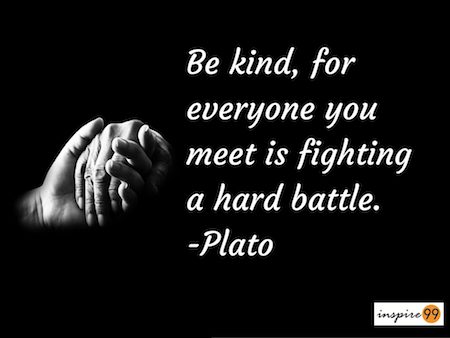
Table of Contents
Meaning of Be Kind Everyone you meet is Fighting a Battle
The meaning of this quote centres around 5 key points below. But the core of it is in kindness, being understanding of each other. Every one of us goes through struggles. What’s easy for us might not be easy for someone else and vice versa. If we take that into account a knd lead with empathy and kindness, we have a good chance at helping someone rather than brushing off their pain as inconsequential.
The meaning of this quote can be summarised in these 5 points:
- Start with empathy, try to understand what people might be feeling
- Being curious about people helps us listen to them
- Love is a beautiful gift that helps both us and the recipient
- Think about others first instead of yourself – life is also about how others are doing
- Finally, give time for love in your life. If you give love, it will come back
Be kind, for everyone you meet is fighting a hard battle.
Ian MaclarenPlato
Who originally said, “Be kind everyone you meet is fighting a battle”?
Who originally said, “Be kind everyone you meet is fighting a battle”? This timeless quote serves as a powerful reminder of empathy, kindness, and compassion in our daily lives. The saying Be Kind Everyone is Fighting a Battle has been widely attributed to several well-known figures over time. Some sources credit Ian Maclaren, while others suggest it was first said by Plato. In other references, the quote is linked to John Watson, Brad Meltzer, Robin Williams, and even Socrates.
As with many famous sayings, the origin of this quote has evolved as it gained popularity. Regardless of its true author, the essence of Be Kind Everyone you meet is Fighting a Battle remains universal — encouraging us to approach others with understanding, patience, and humanity. In this article, we’ll focus more on the meaning, message, and interpretation of this beautiful quote rather than just its attribution.
What does it mean to be kind in difficult situations?
What does it mean to be kind in difficult situations? The heart of this question connects deeply with the message behind Be Kind for Everyone is Fighting a Battle. It reminds us that life is rarely as simple as it appears. Everyone faces challenges — some visible, many invisible — and we may never fully understand what another person is going through.
In such moments, the best thing we can do is choose kindness. Being kind in difficult situations means showing empathy, patience, and understanding, even when it’s not easy. If we cannot help someone, the least we can do is not make things harder for them. When faced with a choice, choose to be human, compassionate, and considerate of others’ struggles.
Ultimately, Be Kind Everyone You Meet is Fighting a Battle teaches us that kindness isn’t just about words — it’s about awareness, respect, and appreciating the unseen challenges others carry.
How can empathy improve interpersonal relationships?
How can empathy improve interpersonal relationships? The timeless message of Be Kind Everyone you meet is Fighting a Battle beautifully captures the power of empathy in human connection. Kindness and empathy go hand in hand — empathy enables us to be kind by helping us understand what others are going through. When we truly empathise with someone, we can respond to their pain with respect and compassion, appreciating their challenges rather than judging them.
Empathy is a powerful emotional skill that deepens trust and strengthens interpersonal relationships. While logic and reason have their place, people are more open to listening and connecting when they feel understood. That sense of understanding comes from empathy.
As long as our purpose is to genuinely help others, empathy allows us to focus on what truly matters. Be Kind for Everyone is Fighting a Battle reminds us that empathy gives us the pause to reflect, connect, and respond with care — ultimately improving our relationships and making our interactions more meaningful.
In some cases, it can also manifest as impatience because we don’t understand the challenges that they are going through. We can’t solve others’ problems all the time, nor can we empathise fully. At these times, the best thing we can do is to remember this message from Ian Maclaren. Be kind for everyone you meet who is fighting a battle – these battles are sometimes visible. Most times, we can’t see the struggle that people are going through.
The main message to understand is that nothing is as simple as it seems. Life is difficult and people are going through many challenges, some of which we can’t even understand. In such situations, we can only be kind and try to understand them and help.
If not, we should at least walk away instead of making things worse for them. When we have a choice to be anything, we can be kind and human about these challenges. Appreciate that people will face difficulties and sometimes we can’t do anything about it. All of it is fine as long as we try to respect them and appreciate the challenges they go through.
Quotes on Empathy
I wanted to answer the question – Can you share some powerful quotes about kindness and empathy? Here are a few select quotes that talk about empathy and kindness to people.
The purpose of human life is to serve, and to show compassion and the will to help others – Albert Schweitzer
I believe that what we regret most are our failures of courage, whether it’s the courage to be kinder, to show up, to say how we feel, to set boundaries, to be good to ourselves. For that reason, regret can be the birthplace of empathy – Brene Brown
No one cares how much you know, until they know how much you care – Theodore Roosevelt
Looking at various means of developing compassion, I think empathy is an important factor: the ability to appreciate others’ suffering. – Dalai Lama
You cannot do a kindness too soon, for you never know when it will be too late – Ralph Waldo Emerson
How do empathy and kindness influence mental health?
Empathy and kindness play a crucial role in enhancing mental health. When we practice kindness, we not only uplift others but also improve our own emotional well-being. Being kind can lead to feelings of connection and belonging, reducing feelings of loneliness and anxiety.
Empathy allows us to understand and share the feelings of others, fostering deeper relationships and support networks. This, in turn, creates a positive feedback loop where kindness begets kindness, leading to improved mental health for everyone involved.
What are the best ways to teach children about empathy and kindness?
Teaching children about empathy and kindness begins with modeling these behaviors ourselves. Encourage them to be curious about others’ feelings by asking questions like, “How do you think that person feels?” or “What might help them?” Create opportunities for children to practice kindness, such as helping a neighbor or sharing with friends.
Books and stories that focus on empathy can also be valuable tools. Discuss characters’ feelings and motivations, reinforcing the idea that everyone has their own battles. Lastly, praise acts of kindness when you see them, emphasizing the importance of these values in everyday life.
How do we balance empathy with personal boundaries?
Balancing empathy with personal boundaries is essential for maintaining our own mental health. While it’s important to understand and support others, we must also recognize our limits. To achieve this balance, start by being aware of your feelings and needs.
It’s okay to say no or step back when you feel overwhelmed. Practicing self-care can help you remain empathetic without sacrificing your own well-being. Remember, being kind doesn’t mean you have to accept all behaviors; it means responding with understanding while still protecting your own emotional space.
What are common misconceptions about kindness?
One common misconception about kindness is that it requires grand gestures or significant sacrifices. In reality, kindness can be as simple as a smile or a few kind words. Another misconception is that being kind means allowing others to take advantage of you. (Is kindness overrated?)
True kindness involves setting boundaries while still offering support. Additionally, some believe that kindness is a weakness, but it actually takes strength and courage to be kind, especially in challenging situations. Lastly, many think kindness should be conditional, but the most impactful kindness is often unconditional, given freely without expectation.
How can we become more empathetic in our daily lives?
To become more empathetic in our daily lives, start by replacing judgment with curiosity. When encountering someone who seems upset, ask yourself what they might be feeling and why. Listen actively when others share their experiences, and validate their emotions without jumping to solutions. (4 Steps To Build The Empathy Muscle – For You, For Me, For Everyone!)
Practicing patience is also essential; understand that everyone has their own struggles. Engage in reflective practices, like journaling about interactions and feelings, to deepen your understanding of others. Lastly, immerse yourself in stories and experiences different from your own to broaden your perspective and cultivate empathy naturally.
References:
- https://en.wikipedia.org/wiki/Empathy
- Quotes from Plato: https://medium.com/@Abdulsalamabdul864/the-5-greatest-plato-quotes-that-still-rule-the-world-2-400-years-later-ab78ab9a26ba#:~:text=When%20you%20refuse%20to%20step,as%20the%20ultimate%20human%20achievement.
- More quotes by Plato: https://yourstory.com/2017/03/29-quotes-by-plato#:~:text=%E2%80%9CAn%20empty%20vessel%20makes%20the,gentler%20and%20more%20dialectical%20way.
This quote was actually by Ian Maclaren (pseudonym or pen name of Rev. John Watson) but is often misattributed to Plato or Socrates
I am completely with you on this Sweety, it certainly is one of the hardest thing to do to maintain that amount of patience and maturity to every situation. Sometimes I feel if we are able to do even 1% of it, it will be a great progress than our natural response and slowly we start getting acquainted with it till it becomes our second nature. I guess that is what is called growth – maybe :)
That’s my most fav quote, although I struggle constantly to emulate it. I find it easier to do for my favorite people, but much less for those I’m not inclined towards. So there’s prejudice involved into impatience as well. Plenty of scope for growth …
Thank you my friend. Glad you liked the post :)
Lovely. Nice thought and well written :)
Thank you Maitreni, happy to see your comments here. Look forward to more thoughts from you :)
Thank you Jyotirmoy :).. All thanks to Plato :)
Thank you UK. Happy you liked it :). I have always found that extremely inspiring, Plato sure knows his way around words :)
A much worthy quote well explained Vinay. Thanks for spreading the good word. :)
nicely written good one, liked it.
Yes, agree. Growth need not be from mere experience..
Well written. Thanks for sharing..:)