
Let’s talk about some of the common misconceptions about entrepreneurship today. It is often fascinating to see how the news spreads, morphs and becomes success stories. They all read well and create an appeal for the readers who enjoy the narrative. Entrepreneurship is the same — too many people talk about how special entrepreneurs were right from the start. It makes us stop and question – how much of it is really true? Are entrepreneurs a completely different breed of people who are born different, with exquisite skills that no one else can emulate?
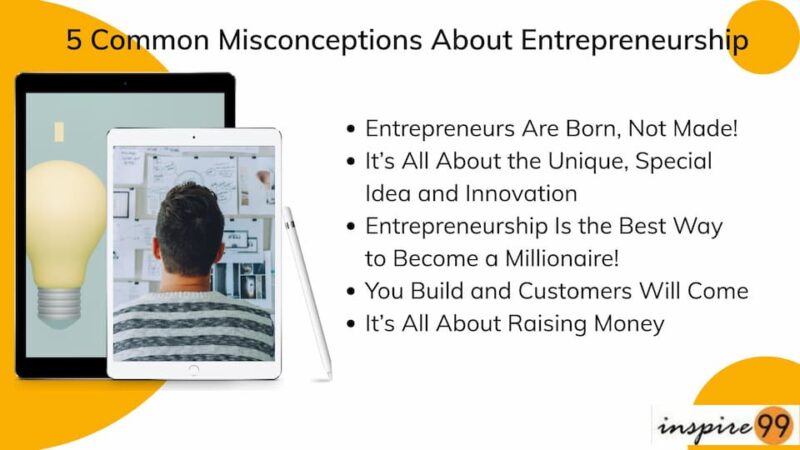
Thankfully, there’s plenty of research to defy that and make entrepreneurship more real and reachable for everyone. With that background, I’d like to talk about the five common misconceptions about entrepreneurship that we often hear about.
Table of Contents
Entrepreneurs Are Born, Not Made!
This has to be the number one myth of being an entrepreneur – that they were born with something special that no one else possesses. This sells the story of a special person, creates an aura and a mystery around them, making them seem like charismatic individuals. But the truth of the matter is, entrepreneurship is about finding a problem and solving it. The business becomes bigger if the same problem is faced by many people and the solution impacts them significantly. Ergo, it is all about value creation.
People also talk about various characteristics of entrepreneurship that make someone succeed. Sure, there will be a few, but it is never a definitive list. We can keep adding to that list, and everything we are as individuals helps to build that business.
Entrepreneurship is closely connected to the person founding a business. Hence, you’ll never escape all the personal traits that help you succeed or fail at business. The key is to ensure that you use them for your benefit and let the business idea play out and do its thing.
It’s All About the Unique, Special Idea and Innovation
Ideas are a dime a dozen. Too many people have great ideas but not many set out to do something about them. Ideas are important — I won’t deny that — but they are not always remarkable. Most of the time, they are simple ideas tied to complex problems that need solving. (You can add a few examples here if you’d like.)
Entrepreneurship need not always be about a product; it can be a business model, a service, or just a different way of looking at things and asking the question “why not?” Don’t let the literature about great ideas and special characteristics fool you. At its core, entrepreneurship is about providing value and creating solutions. It’s important to have a good idea, but it’s not all about the idea.
Entrepreneurship Is the Best Way to Become a Millionaire!
Gosh, this has to be one of the top misconceptions about entrepreneurship. Most entrepreneurs start with the dream of a hockey-stick growth curve, making so much money that they don’t have to work for the rest of their life. They also start with another dream — of being their own boss. Some even think they’ll have more time compared to their overworked jobs. All of this can turn out to be false very easily. (Entrepreneurship has high failure rate)
Entrepreneurship is about business, value creation, and solutions. Money is a great side effect and it is important, but there are many examples of people who didn’t make as much as they hoped and later realised that a regular job might have made them richer. It’s still about the passion to solve a problem and create impact.
You Build and Customers Will Come
This is a fun one but a common misconception about entrepreneurship that has ruined many startups. One of the most common reasons why startups fail is because they don’t have product-market fit. They spend too much time building a product that no one wants. It might sound harsh, but the market is a very competitive place. Customer demands change — even if we do numerous surveys and interviews, the product might still not meet their needs.
Building in a silo sounds great — it gives the false impression of progress. But this is one of the easiest ways to fail in entrepreneurship. You cannot build anything in isolation — the “build it and they will come” mindset doesn’t work. An idea needs to be put into the market as soon as possible to get feedback, adapt to customer needs, and see if you’re moving in the right direction at all.
It’s All About Raising Money
I’ve done this — raised money before we were ready — and that created a whole world of mess. When we started, it felt great because raising money is a very challenging task. The moment we got the funds, the pressure from investors followed.
You’ll suddenly have different people driving you in different directions about how to make money. Some of them might even be right — but it’s hard to stay focused when you’re juggling multiple expectations with very few resources.
Talent is hard to come by for startups — you’ll have to be innovative to attract the best people. Sometimes that means offering shares or even paying above market rate to get them on your side. It’s all about the hustle to make it work. Money helps, but using it the right way and creating opportunities along the way is where the real challenge lies.
Conclusion: 5 Common Misconceptions About Entrepreneurship
I know this doesn’t sound like the most inspirational article on entrepreneurship. Nor is it groundbreaking in terms of the myths and misconceptions about entrepreneurship. But as you know, everything starts with a good level of awareness.
If you are aware of these common misconceptions about entrepreneurship, there’s at least a fighting chance to recognise your opportunities and use them to create your best shot at success.
I’d love to hear from you — what are the most common misconceptions about entrepreneurship or myths of being an entrepreneur you’ve come across in your experience?