
Startup Funding: For a young startup entrepreneur, funding most often appears to be the first biggest hurdle. And in fact it is, especially if you don’t have a financial backup for your business. Thankfully, there are a few options for startup funding to help you gain traction with the idea and capture more customers. As much as I’m a fan of the bootstrapping model with little external funding, I appreciate how valuable funding can be to realise the potential of a business idea.
In this article, we will explore the different types of startup funding models you can consider. The most common one is the equity funding model, as you’d already be aware. However, there are a few more that can give an initial boost and prepare you for the equity funding model option. A pro tip in the equity funding model is to generate value and early customers before entering the equity model. This strategy will help you achieve a better valuation, ensuring that you retain more ownership of your company. The main reason for this is that investors take a higher level of risk at the idea stage, which naturally comes with more scrutiny and corresponding rewards.
5 Types of Startup Funding for new entrepreneurs

High investment startups are difficult. Thanks to AI, some of these risks can be reduced due to vibe coding that can allow you to create prototypes for MVP, customer feedback etc. Using this, as an entrepreneur, you can get customer feedback which can be used as early indicators of interest in your proposition and hence as a reference point for your pitch decks for investment funding. Investors will always appreciate indicators of customer interest. In these early stages of entrepreneurship, your most reliable indicator is customer surveys, feedback responses that you can gain from MVPs and initial product representations.
This can give you some opportunities for bootstrapping in your initial startup days. The key point here is to try and carry your business as long as possible without investment until you get a good customer traction. Now, let’s talk more about the different types of startup investment available for entrepreneurs.
Table of Contents
Bootstrapping, Family and friends funding
Bootstrapping is often the first point of reference for fundraising. As an entrepreneur, I remember trying to scrape together every piece of funding available. This involved cutting costs significantly, trying to do the most with the least amount of investment. Naturally, this slowed our operations, but it enabled us to explore different avenues before gaining traction.
The family and friends model typically extends to your social network. Thanks to modern social networks, this can also include crowdfunding, where people who believe in you can invest. Family and friends funding helps you move quickly during the initial startup days, as it is the quickest way to raise funds without formal processes or paperwork. However, it’s crucial to exercise caution, as your reputation is at stake.
Startup Loans for entrepreneurship
Startup loans are a more serious option because they usually require collateral and come with personal liability. These loans involve a higher level of due diligence and may not be fast enough to raise large sums of money depending on your financial situation. They can add significant pressure on your business even before it starts generating profits.
However, loans are easier to obtain because you don’t have to prove your business model to banks, although a solid business plan is still necessary. The advantage of startup loans is that you retain 100% ownership of your business, allowing for quicker decision-making.
Key tips about startup loans
- Loans come with personal liability and risk.
- They are generally faster than equity funding options.
- You maintain autonomy with loans, keeping all equity.
- Be mindful of interest payments, which add financial pressure.
Grant Startup Funding
Grants are one of the best ways to raise funds for a startup, as they don’t carry any risk. Numerous government-funded opportunities provide grants for specific sectors or businesses that create social impact. However, my experience with grant funding has taught me that these funds are strictly monitored, limiting how you can use them.
While grants can be a fantastic source of funding, they come with their own limitations regarding usage and reporting. Partnering with organizations experienced in grant writing can help streamline this process.
Key tips about grant funding your startup venture
- Some grants may require equity exchange, so be cautious.
- Grant applications can be time-consuming, requiring detailed reporting.
- Grants are often more accessible when partnering with universities.
Crowdfunding for Startups
I find crowdfunding to be an exciting avenue for startup funding. Many successful businesses have leveraged this method, especially in the B2C space. Crowdfunding can also be an extension of the family and friends funding model.
However, it requires a strong narrative and quality promotional content. Investing time and resources into creating compelling videos and marketing strategies is crucial for success.
Key tips about crowdfunding:
- Choose the right platform based on your product or service.
- Most platforms expect you to have 20-30% of your funding committed beforehand.
- Be aware of the fees associated with different platforms.
Tactical Advice for crowdfunding
However, when I spoke to these crowdfunding entrepreneurs, the overarching factor was that they already had a certain amount of money committed from different investors. Say for instance they were raising $50,000. These crowdfunding platforms would encourage them to already have about $20,000 committed.
Due to the way the platforms are designed, these crowdfunded ventures which have a higher commitment early on are advertised more and they come on the top of the list. Hence, although crowdfunding sounds like a great idea to reduce the risk, it also can be boosted with a few other tactics that have worked in the past.
Equity fundraise Model in Startup Funding
Equity funding is undoubtedly the most popular format of startup funds. It allows you to bring on early investors who are willing to take risks for potentially high returns. This type of funding is critical for startups that have progressed past the idea stage.
As a founder, giving up equity is a significant decision. You need to consider your business’s valuation carefully. If your business requires multiple rounds of investment, your share will dilute over time.
Key tips about equity funding:
- Equity funding is the most popular form of startup funding.
- It de-risks personal liability and allows for quicker development.
- Be prepared for multiple funding rounds and their impact on ownership.
- Consider legal tax breaks for investors to incentivize them.
Different Stages of Startup Equity Funding
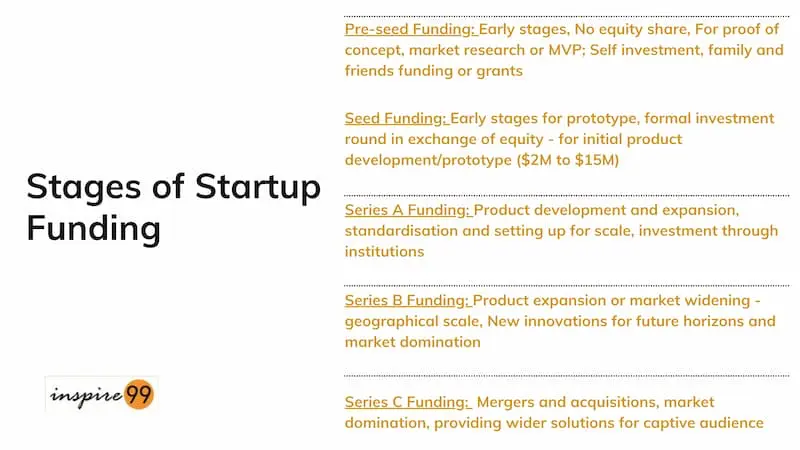
There are typically 3 stages of funding for a startup. These funding stages are classified under equity funding where you’ll give up a part of your company’s ownership/stake in exchange for money. This money will be used to develop the product or expand the scale and scope of your startup depending on its maturity.
Pre seed funding and Seed Funding
This occurs during early stages of the startup. Pre-seed funding is used to develop the proof of concept or initial operations of the business. The ideal outcome of a pre-seed fund is to be able to develop a minimum viable product that can be used as proof of success for next stage of business development. Incubators are great places to support opportunities for pre-seed funding. Some pre-seed funds come as a part of incubators or even some university funds that can be very handy. Other routes of pre-seed funding are family and friends or self-investment.
Seed Funding: During the pre-seed fund, we normally don’t give out any equity. The first time you focus on equity funding is during the seed funding stage. By this stage, you’ll already have a credible business plan, a minimum viable product and some early customer feedback to support your idea. At this stage, angel investors are more forgiving about the detail in your approach and the early stages of product development. A seed stage represents a high risk for an investor and naturally, they will get a higher % of the ownership of your company as compared to investing in the later stages of your startup.
While you’re asking for seed funding, make sure that your business plan is built for scale and covers situations of future fundraisers. They will ask you questions about dilution and reduction in share value in further rounds as you raise further investment.
Series A, Series B and Series C Funding
After the seed funding round, your next equity fundraiser is Series A funding. The seed fund is generally used for product development. In Series A funding, investors will expect a level of success from a startup. At this stage, they will also expect your startup to have some initial customers. In an ideal world, they’d like to see some impressive customer names to add credibility to your product.
Series A funding is to expand the business and increase the product adoption. Before this stage, you should have completed the product prototype and even the first delivery. Series A funds raise from $2M to $15M according to Investopedia. The minimum expectation however is that your idea has progressed from an idea stage to actual product with a few adopters.
Series B Funding
Series B funding is all about market expansion. Remember, the purpose of a startup is to scale and provide a repeatable business model. In this stage, the investors will expect you to have an expansion plan. Sometimes, these expansion plans in Series B funding are about setting up genuine new companies to expand your market share. geographical units and expanding the size of the customer base. The business at this stage has already entered the inorganic growth phase where the mantra is to sell and sell more. You can use a part of this investment for continuous product development. But this should feed into your expansion plans and future innovations to increase customer appetite on your solutions. You should be well beyond product market fit while applying for series B funding.
Series C Funding
Series C funding is exciting. At this stage, you already have a successful business and are looking for further expansion. This expansion can come in the form of acquisitions, buying out other companies to expand your market share. At this stage, you’re well beyond startup phases and into business domination. Series C startups command large valuations and are ripe for a great buyout themselves. It is looking for rapid expansion in the market and this comes with significant investment to ramp up sales and marketing functions. If you’re lucky, you’ll be able to focus on next-horizon investments that can be very exciting.
These are the types of investments you can focus on as a startup founder. Depending on the goals of your startup, define your investment plan to reach out to the right investors.