
Types of entrepreneurs: In this article, let’s talk about the four types of entrepreneurs and the differences between them. The underlying definition for all entrepreneurs is the ability to take risks. Depending on the types of risks and potential outcomes, we can define the type of entrepreneur and their business. The main reason to separate these types of entrepreneurs is that it helps you attract the right type of investors, accelerators, and partners.
As you know, about 30% of new businesses fail within the first two years, and around 50% don’t make it to the five-year mark. A lot of that comes down to choosing the wrong type of business model.
Table of Contents
What are the different types of entrepreneurs?
Entrepreneurs can be categorised based on their approach, business model, and goals. Understanding these distinctions can help you navigate your entrepreneurial journey more effectively. An entrepreneur is someone who takes risks. This business can either be a large or small one. At the end of the day, an entrepreneur is someone who takes risks, usually by starting a business.
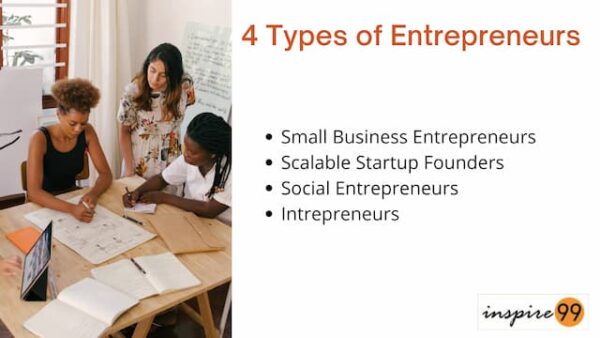
The size of risk doesn’t define the type of entrepreneur – instead, the field in which you operate can help you classify entrepreneurship. The 4 types of entrepreneurs are Small Business Entrepreneurs, Scalable Startup Founders, Social Entrepreneurs and Intrapreneurs.
Small Business Entrepreneurs
I have a soft spot for small business entrepreneurs. They represent a real need and turn value into something tangible. Unlike scalable startup entrepreneurs, who often have an exit plan from day one, small business entrepreneurs focus on building something sustainable. Think of it as a “company of one” concept where the business expands to meet customer needs without the pressure of chasing massive profits.
Small business entrepreneurs have fewer employees and generally offer existing products or services. This is the main difference between small business entrepreneurs and scalable startup entrepreneurs. Most small businesses focus on existing customers and expanding their reach. The amount of innovation in such types of businesses is lower. However, small business entrepreneurs have a faster time to market and an existing network, making it feasible to focus on growth and expansion quickly.
Characteristics and Common Challenges of small business entrepreneurs
You can spot the small business entrepreneurs from their risk appetite and the speed at which they can process things. Since most of these businesses are organic, they’re slower to adapt and cautious about spending money. Some of the common characteristics and challenges of small business entrepreneurs are
· Adaptability: They can pivot quickly based on customer feedback and market needs.
· Resourcefulness: Often working with limited budgets, they find creative ways to solve problems.
· Community Focus: They build strong relationships with local customers and suppliers.
· Passion for their Product: Driven by a love for what they do, they often go above and beyond for their customers.
· Limited Access to Funding: Many struggle with securing capital, relying on personal savings or loans.
Examples of Successful Small Business Entrepreneurs
- Ben & Jerry’s: This ice cream company started small and became a global brand known for its social activism.
- Warby Parker: These guys revolutionised eyewear by offering affordable glasses online and focusing on social responsibility.
Scalable Startup Entrepreneurs
Now, scalable startup entrepreneurship is a whole different beast. It’s exciting and full of potential! You’re looking at businesses that can grow rapidly, and they often attract a lot of attention from investors. They are characterised by huge growth potential and massive risks. Most times, when people refer to entrepreneurs, they mean scalable startup entrepreneurs.
These businesses are supported by business plans, incubators, startup funding, and other activities. They have a huge market potential and can provide substantial returns. This is likely why investors are particularly interested, given their overwhelming potential for growth and expansion. Scalable Startup Entrepreneurship definition
Startup Funding and Growth Potential
Funding can come from various sources—angel investors, venture capital, crowdfunding—you name it. But here’s the thing: while money is great, it’s often the connections that investors bring to the table that matter even more. When I started my own business, I quickly realised that knowing the right people could be a game changer.
From the outset, scalable startup entrepreneurship is about creating value. They typically require heavy early investment, experience slow breakeven points, and then achieve phenomenal growth. This type of business comes with large risks and potential for failure, but the payouts can be remarkably high.
Characteristics and Common Challenges of Scalable Startup Entrepreneurs
Scalable startup entrepreneurs typically face these traits and challenges:
- Innovative Mindset: Always on the lookout for new ideas and solutions.
- High Risk Tolerance: They’re comfortable taking significant financial risks for potential high rewards.
- Networking Skills: Building relationships with investors and mentors is crucial.
- Pressure to Perform: There’s a constant demand for growth and quick returns.
- Need for Flexibility: They must pivot quickly based on market feedback and investor demands.
Social Entrepreneurs
I really admire social entrepreneurs. They’re all about making a difference, where profit isn’t the only goal. Sure, you need some capital to keep the lights on, but the primary focus is on social impact. These types of businesses have a social impact at the heart of their business plan. Sure, profits are important, but they are not the primary motive for these types of entrepreneurs.
You often see social entrepreneurs tackling issues like education, poverty alleviation, and environmental sustainability. They sometimes have government backing or support from philanthropists, which can be a huge advantage. They follow a similar route as a traditional business plan; however, this type of entrepreneurship differs from an NGO or charity where the focus is more on sustenance than growth. Social entrepreneurship borrows the growth philosophy from startups but centres on social impact.
Examples of Social Entrepreneurs
- Muhammad Yunus: Founder of Grameen Bank, he pioneered microcredit to empower the poor and won a Nobel Peace Prize for his efforts.
- Blake Mycoskie: The guy behind TOMS Shoes, who built a model where for every pair sold, a pair is donated to someone in need.
Characteristics and Common Challenges of social entrepreneurs
Social entrepreneurs typically exhibit these traits and face these challenges:
- Mission-Driven: They are focused on social impact more than profit.
- Collaborative: Often work with various stakeholders, including governments and NGOs.
- Creative Problem Solvers: Find innovative ways to tackle social issues.
- Funding Challenges: They may struggle to secure traditional investment, relying more on grants and donations.
- Balancing Act: Managing the dual goals of social impact and financial sustainability can be tricky.
Intrapreneurs
Let’s not forget about intrapreneurs! They work within existing organisations and use company resources to develop their ideas. It’s probably the safest type of entrepreneurship out there. An intrapreneur is someone who creates a new venture within an existing company. As an intrapreneur, you benefit from the backing of your company to help you create value.

However, you will not have complete ownership of the business as you would in a standard entrepreneurship model. Instead, you can leverage the company’s resources, such as brand recognition and customer exposure, to expand quickly.
Characteristics and Common Challenges of Intrapreneurs
Intrapreneurs often have these traits and face these challenges:
- Resource-Leveraging: They utilize company resources to innovate.
- Limited Autonomy: Their ideas must align with company goals, which can stifle creativity.
- Supportive Environment: They enjoy backing from established networks and resources.
- Internal Politics: Navigating corporate structures can be challenging.
- Pressure to Deliver: They still face expectations for results, even within a company.
Differences Between Entrepreneurs and Intrapreneurs
The key difference? Entrepreneurs are out there on their own, taking big risks, while intrapreneurs have the safety net of a company. The choice really depends on your risk appetite and how strongly you believe in your idea. If you have the right idea, scaling up and reaching a wider customer base will be easier in this type of entrepreneurship. For a more in-depth understanding, you can find a detailed comparison between intrapreneurship and traditional entrepreneurship.
Characteristics of Successful Entrepreneurs
Each type of entrepreneur faces unique challenges, from securing funding to market competition. Recognizing these hurdles is essential for success. Some of the common characteristics of successful entrepreneurs are:
- Vision
- Passion
- Self-confidence and belief
- Creativity and Problem Solving
- Risk Appetite
- Ability to Persuade and Convince
- Adapting to change and being flexible
- Working with people – Collaboration
How to Become an Entrepreneur
Want to dive in? Start by talking about your idea with everyone you meet. Don’t worry too much about someone “stealing” it; most people won’t act on it. Your real value lies in your ability to execute. Get feedback, find pitching events, and network like crazy! Aspiring entrepreneurs can benefit from mentorship, networking, and continuous learning. Resources like business incubators and online courses can provide valuable support. How to Become a Startup Entrepreneur?
So, as you can see, it’s super important to identify the right type of entrepreneurship for you. Depending on where you position yourself, you can attract different investors and resources. Think about what makes sense for your vision and what you want to achieve. That clarity will help you move quickly and effectively in this fast-paced world. Talk to people, articulate your ideas, and take the leap. The entrepreneurial journey is waiting for you!
References:
https://en.wikipedia.org/wiki/Intrapreneurship
https://www.investopedia.com/articles/personal-finance/040915/how-many-startups-fail-and-why.asp
I do agree with all the ideas you have introduced on your post They are very convincing and will definitely work Still the posts are very short for newbies May just you please prolong them a little from subsequent time Thank you for the post