
Love your job but never fall in love with your company: This is a lovely quote by Narayana Murthy talking about loyalty while working for a company. In this article, we will explore the meaning, inspiration and practical steps in relation to the quote. The quote makes a distinction between loving your company vs loving your job. A job is more permanent than a company which paints a different perspective on the quote:
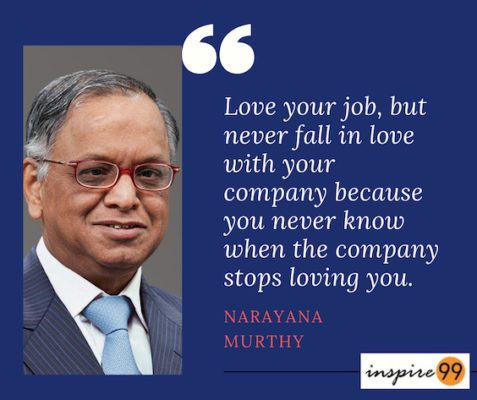
Love your job but never fall in love with your company because you never know when the company stops loving you – Narayana Murthy
Table of Contents
Love Your Job but never fall in love with your company Meaning
Work is an important piece of our life. It is a great chance event to fall in love with what we do. The meaning of this quote is in the caution against falling in love with the company. The core of its meaning is about separating the love for job and the company. Using the same analogy – a job is more long lasting compared to your tryst with a company.
The other side of this quote is – what happens when the company stops loving you. If you are a part of a large company, at some point, you will be a bottomline number viewed on a spreadsheet. From that perspective, the idea of falling in love with a company feels daunting and something to exercise caution against. Instead, it is akin to a transactional relationship where you do something (a job) because you love that. If you happen to love the company too, that’s a great place to be.
What is the meaning of – Love your job but never fall in love with your company?
If you were running the company, it becomes an objective process of making profits, surviving and ensuring that it sustains the challenges posed by the economy. I love the idea of a company that has a purpose to it, but the truth is that it matters only when a company’s survival is taken care of. Hence a company can never afford to love you as much as you love your job.
A company can give you a sense of belonging, fun and team etc. It is a beautiful experience. But a company is a collective of people and you can never be a special one for the company. If it has to survive, it needs to depend on the contribution of everyone involved.
Please don’t mistake me and assume that I’m sending a message that you should hate your company. Contrary to that, I’m in love with the companies and often find myself addicted to work – a little more than I should. However, that doesn’t support the point that falling in love with your job is not the same as falling in love with your company.
Love your job but never fall in love with your company because you never know when the company stops loving you Inspiration
A job means transferrable skills and falling in love with your job, investing your time in it and continually growing has a benefit. It is self development that makes you more employable and keeps you alive. However, a company is a moving thing – management, process, cultures and sometimes even the philosophies change.
We must be smart enough to recognise these changes and identify when it stops serving us. This quote – love your job but never fall in love with your company goads us to think about self reliance and doing what serves us the best.
Loving your job is not the same as loving your company
Jobs can be fun and fulfilling, and I’ll admit—I’ve been guilty of falling in love with both the job and the company. However, the idea of company loyalty has evolved. It’s no longer about staying with one company for life but about continuously updating our skills.
In a simple demand-supply sense, as long as you have relevant skills and stay good at what you do, you will always find opportunities. The best part? You’re not tied to a company or its limitations—but to your own capabilities, allowing you to search for what works best for you.
This quote is not about hating your company. It’s about embracing reality—that loyalty to your job and skillset will give you better long-term returns than loyalty to a company.
A company’s love is not the same as your love to the company
When we work for a company, we are naturally influenced by its culture. Sometimes, this culture inspires us to do more, which is fantastic—as long as it aligns with our personal goals.
But over time, organisations change their priorities. What once inspired us may no longer do so.
At that point, the only thing within our control is our own skills, growth, and career choices.
A company is too large an entity to be shaped by an individual. The crux of this quote is about focusing inward—ensuring that you keep improving your value and contribution, instead of relying on a company to shape your career. So please, just love your job!
Why Should You Not Love Your Company?
A company’s primary mandate is to perform well and return value to shareholders.
Even if you are the best performer, the company might still not be able to do justice to your contributions.
Why? Because companies must:
- Manage stakeholder demands
- Ensure profit margins
- Make tough business decisions
In such a scenario, your job and skills are more dependable than the company itself.
The most important takeaway here is that your job skills can be replicated elsewhere. This job-first mindset protects you in case the company isn’t doing well or decides to restructure. Hence the phrase – love your job but never fall in love with your company!
You never know when the company stops loving you
One of the most powerful moments when this quote becomes painfully relevant is during layoffs and redundancies.
A company will never love you back in the same way you love it.
This forces an important question:
- Should we even think of company loyalty in the same way anymore?
- Or should we focus on becoming highly skilled individuals who always have options?
Maybe in the previous generation, company loyalty made sense because job opportunities were limited. But today, for talented individuals, there are plenty of opportunities.
If you’re good at what you do, companies compete for you—which means your best bet is on yourself, not on a company.
Some controversy from Narayana Murthy which makes you rethink how important you as an individual are for a company! – I do not believe in work life balance
Independence in loving your job Vs Dependence in love for the company
With increased skills and abilities, you make yourself more indispensable to a company. I’m not saying you should quit your job or avoid committing to a company. But you should build your capabilities to a level where you are never entirely dependent on a company.
Loving your job gives you more options
- You depend more on yourself than on the company
- You continuously improve your skills
- You create multiple opportunities for yourself
The validity of Narayana Murthy’s quote – love your job but never fall in love with your company, forces us to reflect on some hard truths.
At the end of the day, we must decide what works best for us.
Creating independence from loving your job
- Love my job
- Focus on improving my skills
- Stay adaptable and open to multiple opportunities
… rather than hoping that an organisation will treat me with the importance I think I deserve and curate a career path for me.
Because loyalty is a two-way street—and in today’s world, it’s always smarter to bet on yourself than on a company.
Related:
- Skill shift: Automation and the future of the workforce
- https://www.infosys.com/about/management-profiles/narayana-murthy.html
- https://www.forbes.com/profile/nr-narayana-murthy/
I think that it’s partially true. Because without loving your company how you can be a loyal, devoted and valuable resource. Love doesn’t mean any lifetime contract but still it make people mind to always think about there selves only not about company or organization who provided them opportunity, learning and remuneration.
You have a very strong point there Raj. It is unfortunately becoming an immediate manager. Although this is not the intention and there is supposed to be adequate flexibility that the company stays beyond a single person, it just is not as easy as it sounds.
An unfortunate thing with large companies is that people don’t seem to listen as often as they should. This makes them lose quite important resources. People have a lot of choices today. The company must strive to make the job interesting for them and do take some steps to keep the employee engaged and interested in their job. After all, their loyalty will be to what feeds their own personal goals. If the company fails to understand this, it starts losing its people right from the start. And in the end the company is left with a bunch of no good egoistic people who don’t have a lot in them to take the company forward.
This reminds me of a funny joke:
Finance Director: “Why are we spending so much money on training. What happens if these employees take all this training and leave?”
Manager: “Well, what happens if we don’t and they stay?”
That sums it up doesn’t it? People are very smart and clever. If you treat them right, they find reasons to stay. If not, they find reasons to leave. After all, not many people love a company for company’s sake anymore.
True Suman, I guess the company can always survive without a resource. If we treat the companies also as a resource with which we are fulfilling our goals, perhaps we are on an equal footing with them after all :)
Can’t agree more, Give and Take is the way to go as long as it’s not one party who always gives and the other takes.
The company is the person who is heading it at a particular moment (Sadly the reality. Ideally it should be driven by corporate values) and his /her beliefs and priorities. Therefore the quote of Mr Murthy is spot on. You will do well instead to enhance your capabilities as a professional. which is more satisfying and lucrative in the long run….
Very interesting. I really like the representation in the form of a contract. There’s no concept of a lifetime job or company anymore. We work for a set of reasons – money, self actualisation and the joy we derive from the type of work we do. If company A does not provide this, there is a company B which can. Although companies don’t really enjoy this situation, it gives them enough motivation to treat their employees better. If they don’t , the employees have a lot of choice. If on the other hand there’s too much loyalty to a company, things can go awry when the company hits hard times or management changes or even goes through some financial struggles. Always a good choice to fend for ourselves and keep control within us. After all who cares better about us than our own selves?!
That is so very true and why not it comes from a person with vision. In a corporate environment today, an employee and the organisation share a mutual relationship to deliver a job under a contract. One delivers and the other pays as long as that relation last and either one can terminate this as per the contract.
Gone are the days where one would think of retiring from the fist job and maybe the next generation gets into it like what we have seen in Bollywood movies.
Thanks Sonia, nice to hear about your experience. I suppose these things are never easy. My previous stint was almost similar, it was an early stage company and I really liked it. But after a while it wasn’t doing much for my career. The company had me for its benefit, but the job wasn’t as exciting anymore nor was it fulfilling my needs. That led me to an MBA. Experiences have a nice way of offering us some great insight about ourselves. I’m glad to hear that you made a move when you did. It’s always easier to move forward from your own decision rather than a company offering a rude shock..
Curious to know though, what do you do in solopreneurship?
I worked in the corporate world 8 years before taking the plunge into solopreneurship. I made the mistake of falling in love with the company instead of my job in my first job post MBA. I am glad that I moved on before I could become redundant after a change of my reporting authority