
Fabian Entrepreneurs: This is a rather interesting definition for an entrepreneur. The term fabian entrepreneurs refers to a business leader who is sceptical of change and innovation. Most of the conversations we have about entrepreneurship are about taking risks, having a higher risk appetite and going after solutions that can disrupt the space.
As much as this definition seems to be at opposite ends of the spectrum of entrepreneurship, I find it interesting because most entrepreneurs start off with risk. However, when they see success and are afraid of losing their position, the fabian entrepreneurship approach comes into question.
Table of Contents
Is a Fabian Entrepreneur a real entrepreneur?
The term Fabian entrepreneurs is an oxymoron because it conflicts with the idea of entrepreneurship which is all about taking risks. Fabian entrepreneurs are business leaders who are sceptical of change and innovation. Mostly we find this type of entrepreneurs in organic businesses that have grown without an external fund investment and are driven by a high-risk environment. This type of entrepreneur wants to assess the risks thoroughly before investing in disruption.

The entrepreneur’s myth of first mover advantage
You’d rarely see Fabian Entrepreneurs in businesses which are driven by changes in the environment and are often considered the laggards that follow business trends. In other words, they’d wait for someone else to take the risks and prove the market condition before they get involved. By doing so, Fabian entrepreneurs often lose the first mover advantage and have a steep competition of fighting entrenched businesses.
On the flip side, sometimes the first mover advantage is a myth. The first movers take a huge amount of risk to prove the market, educate the customers who can then be taken over the competitor. Although a Fabian entrepreneur might sound like someone who doesn’t want to take risks, they can be great at attacking the market once the ability of a market or service is proved.
Characteristics of Fabian Entrepreneurs
Although the defintion of fabian entrepreneurs conflicts with the traditional meaning of entrepreneurship, I can see that they can be impactful in the small business sector. Here in there’s an established market where the Fabian Entrepreneurs are clear of their competitive advantage and are able to exploit their advantage by being good at price competition and taking over that specific type of market. These entrepreneurs will not move the market, but can be very good and agile at adapting to the market conditions and respond to change once someone else takes the risks.
Of course this means that Fabian Entrepreneurs are taking a large risk and in some cases risking their existence by not adapting to the market conditions quick enough. We can speak to three predominant characteristics of Fabian Entrepreneurship:
- Risk Averse Nature
- Agility and low speed of adaptation
- Dependence on steady and stable growth
We can easily extrapolate these to other characteristics as well. But these three should give you a flavour of how these types of entrepreneurs are different.
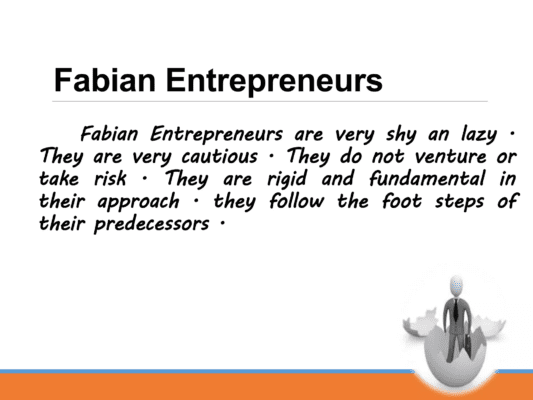
Fabian Entrepreneurs are Risk Averse
By nature, these types of entrepreneurs are risk-averse. They will wait for something to have proved market value before adapting to it or making a change. Fabian Entrepreneurs are well versed with existing market conditions and are best placed to exploit them as long as they don’t change. However, they’re not ideally placed to respond to disruption. They will act when their bottom-line and is forced to change.
Adaptability and speed of change
Fabian entrepreneurs are also change-averse. Due to the nature of their business, they are neither designed for scale nor large changes to exploit market conditions by adapting. Since they are risk averse, they will wait to see how others are performing before implementing changes. If you are working with such entrepreneurs and want to establish a change, your best opportunity is to show case studies of other successes and address the risk-averse nature of these business leaders.
Dependence on Steady and stable growth
These entrepreneurs focus on incremental growth and invest accordingly. They closely attune their budget and growth plans to the organic growth projections and ensure that resources are allocated accordingly. These plans are based on existing product and service lines. The best way to articulate growth for these entrepreneurs is by refining a pitch for incremental development. A radical approach is bound to scare the Fabian Entrepreneurs away from entertaining a new idea.
Advantages of Fabian Entrepreneurs
Although Fabian Entrepreneurship is different compared to most of the startup lingo out there, it has its own advantages and challenges. The fact that they exist is proof that they have some things that work for them. The market has a good way of eliminating redundancy. Let’s try and explore a little more the advantages for Fabian Entrepreneurs.
- Cautious Risk Management: Their careful approach to risk can help avoid costly mistakes and failures.
- Sustainable Growth: By focusing on steady progress rather than rapid expansion, they often build a stable foundation for long-term success.
- Thorough Planning: They tend to conduct in-depth research and analysis, which can lead to well-thought-out strategies and decisions.
- Resilience: Their conservative nature often makes them more resilient during economic downturns, as they are less likely to overextend themselves.
- Stable Operations: Fabian entrepreneurs prioritize stability, which can foster a reliable work environment for employees and stakeholders.
- Strong Relationships: Their cautious approach often results in building strong relationships with clients and partners, based on trust and reliability.
- Focus on Quality: They may emphasize quality over quantity, leading to better product and service offerings.
- Adaptation to Change: While they may be slow to act, when they do make changes, those changes are often well-considered and effective.
Disadvantages for Fabian Entrepreneurs
Fabian entrepreneurs are cautious and take their time to take decisions. They often wait for the market to be certain of the risks and opportunities and hence can be very slow in adapting to market conditions. The key disadvantages of Fabian entrepreneurs are:
- Slow Decision-Making: Their tendency to analyse before acting can result in missed opportunities, especially in fast-moving markets.
- Risk Aversion: This cautious nature can lead to avoiding potentially profitable ventures that involve risk, limiting growth potential.
- Lack of Innovation: Fabian entrepreneurs may stick to traditional methods and resist change, causing stagnation in innovation and creativity.
- Competitive Disadvantage: In highly competitive industries, their reluctance to take bold steps can cause them to fall behind more aggressive competitors.
- Limited Market Adaptability: Their careful approach might hinder their ability to quickly adapt to changing market conditions or consumer preferences.
- Underutilisation of Resources: By being overly cautious, they may not fully leverage available resources or explore new markets.
- Dependence on Established Practices: Relying heavily on proven methods can result in a failure to explore new opportunities or diversify.
- Lower Profit Margins: A conservative approach may lead to lower profit margins compared to more dynamic and risk-taking entrepreneurs.